Electromagnetic Waves: What They Are, How They Travel & The Full Spectrum
From radio signals that bring music to your car to the sunlight that warms your skin and X-rays that help doctors see inside your body — all are electromagnetic waves. Discover how they form, why they can travel through empty space, and the amazing electromagnetic spectrum.
What Are Electromagnetic Waves?
Electromagnetic waves (EM waves) are waves that consist of oscillating electric and magnetic fields. They carry energy from one place to another without needing any physical medium (like air, water, or a rope) to travel through.
Unlike sound waves or water waves, electromagnetic waves can travel through the vacuum of space at the speed of light (approximately 3 × 10⁸ m/s in vacuum). This is why sunlight reaches Earth from 150 million kilometers away in just about 8 minutes.
Electromagnetic waves and electromagnetic radiation refer to the same thing. The term “radiation” here simply means energy traveling through space in the form of waves.
How Are Electromagnetic Waves Formed?
EM waves are produced when electric charges accelerate or when electric and magnetic fields change together. A changing electric field creates a magnetic field, and a changing magnetic field creates an electric field. These two fields continuously regenerate each other as they propagate through space.
The electric field and magnetic field in an EM wave are always:
- Perpendicular to each other
- Perpendicular to the direction the wave is traveling
- In phase (they reach maximum and minimum at the same time)
This self-sustaining oscillation allows the wave to keep traveling indefinitely until it interacts with matter.
Visualizing an Electromagnetic Wave
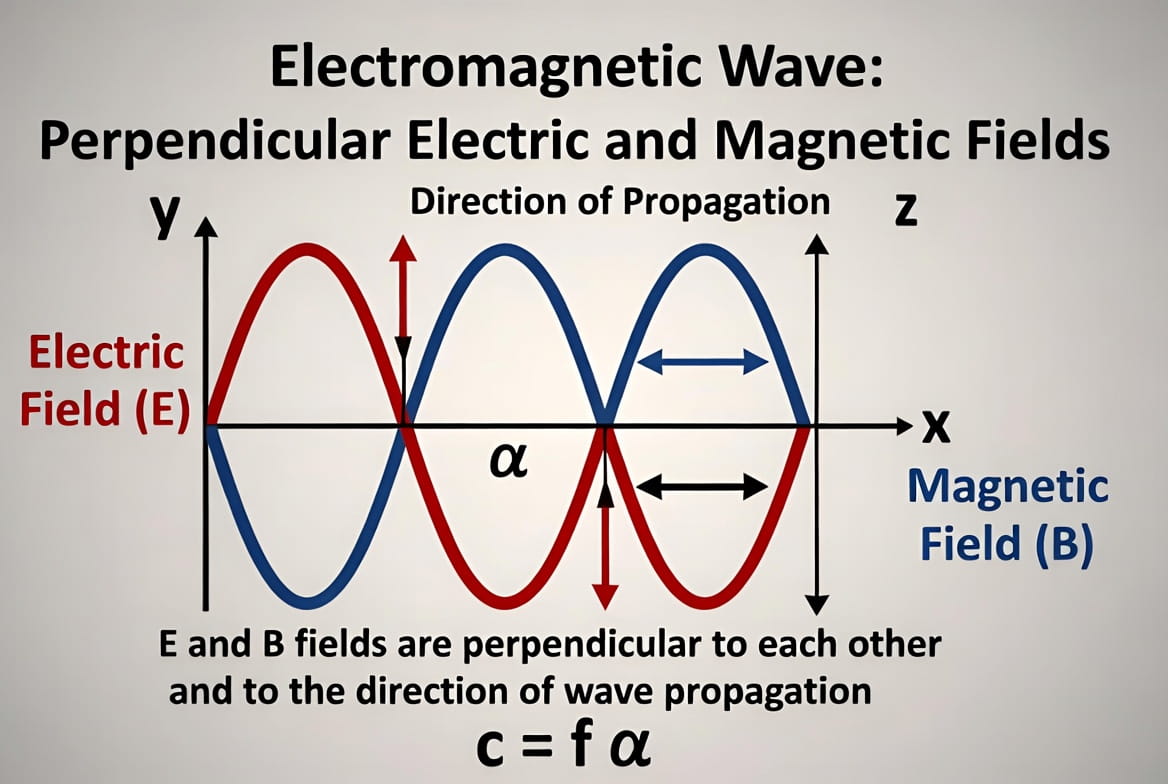
An electromagnetic wave has electric (E) and magnetic (B) fields oscillating at right angles to each other and to the direction of propagation.
Key Properties of Electromagnetic Waves
- Transverse waves: The oscillations are perpendicular to the direction of travel.
- No medium required: They travel perfectly through vacuum.
- Travel at speed of light: c = 3 × 10⁸ m/s in vacuum (slower in materials).
- Carry energy: The energy depends on frequency (higher frequency = higher energy).
- Can be reflected, refracted, diffracted, and polarized.
Electromagnetic Waves vs Mechanical Waves
| Feature | Mechanical Waves | Electromagnetic Waves |
|---|---|---|
| Medium Required? | Yes (solid, liquid, or gas) | No – travel through vacuum |
| Examples | Sound, water waves, seismic waves | Light, radio waves, X-rays, microwaves |
| Nature | Can be transverse or longitudinal | Always transverse |
| Speed | Depends on the medium | Constant in vacuum (speed of light) |
| What Oscillates? | Particles of the medium | Electric and magnetic fields |
This is why we can see stars billions of light-years away, but we cannot hear any sound from space.
The Electromagnetic Spectrum
The electromagnetic spectrum arranges all EM waves by wavelength or frequency. Longer wavelength means lower frequency and lower energy. Shorter wavelength means higher frequency and higher energy.
Main Regions of the EM Spectrum (Longest to Shortest Wavelength)
- Radio Waves – Longest wavelengths (meters to kilometers). Used in radio, TV, and communication.
- Microwaves – Used in microwave ovens, Wi-Fi, radar, and satellite communication.
- Infrared (IR) – Felt as heat. Used in remote controls, thermal imaging, and night vision.
- Visible Light – The only part we can see with our eyes (red to violet).
- Ultraviolet (UV) – Causes sunburn. Used in sterilization and fluorescent lamps.
- X-rays – Penetrate soft tissue. Used in medical imaging.
- Gamma Rays – Highest energy. Produced by nuclear reactions and cosmic events. Used in cancer treatment.
Examples of Electromagnetic Waves & Energy
Radio Waves
Carry radio and television signals over long distances.
Microwaves
Heat food by making water molecules vibrate.
Visible Light & Infrared
Sunlight brings us visible light and warmth (infrared).
X-rays & Gamma Rays
Used in medicine for imaging and cancer treatment.
Frequently Asked Questions
What do electromagnetic waves carry?
They carry energy (and information) in the form of oscillating electric and magnetic fields.
Do electromagnetic waves need a medium?
No. This is the biggest difference from mechanical waves like sound.
Is electromagnetic energy potential or kinetic?
It is a form of radiant energy that can be converted into other forms (heat, electrical, chemical, etc.).
Continue Mastering Physics Fundamentals: