Centripetal Force: Formula, Units & Real-Life Examples
Learn why cars stay on curved roads, satellites orbit Earth, and rollercoasters don’t fly off. Master the centripetal force formula, its units, direction, and solved problems.
What is Centripetal Force?
Centripetal force is the net force acting on an object moving in a circular path that keeps it moving toward the center of the circle. It is not a new type of force — it is the result of other forces (tension, friction, gravity, normal force, etc.) acting together.
Without centripetal force, objects would move in straight lines (Newton’s First Law). The word “centripetal” means “center-seeking.”
The Centripetal Force Formula
Centripetal Force = Mass × (Velocity²) / Radius
Newton (N) = kg·m/s²
Fc = m r ω²
(where ω is angular velocity in rad/s)
Always toward the center of the circle (perpendicular to velocity)
Understanding Centripetal Force Step by Step
Centripetal force causes centripetal acceleration (ac = v²/r). From Newton’s Second Law (F = ma), we get Fc = m ac = m v² / r.
Important points:
- The faster the speed (v) → the greater the required centripetal force
- The smaller the radius (r) → the greater the required force (tight turns need more force)
- Centripetal force is always perpendicular to the object’s velocity
Visualizing Centripetal Force
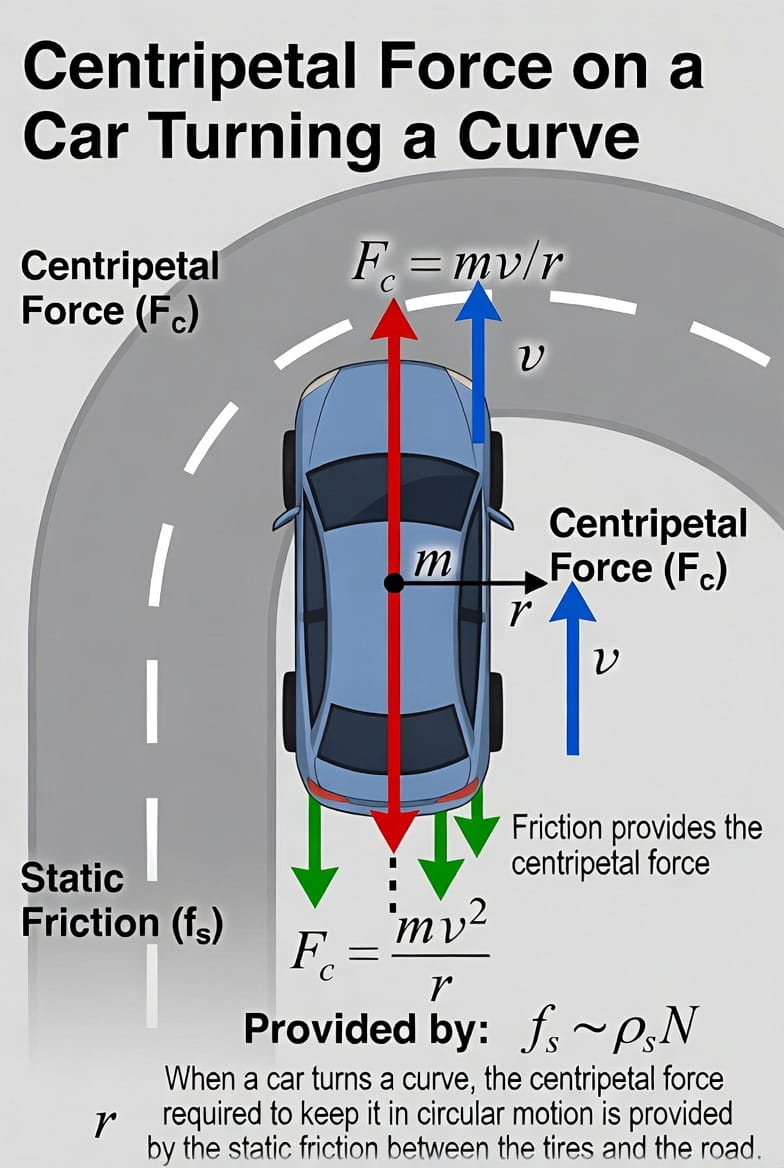
Friction between tires and road provides the centripetal force when a car turns.
Real-Life Examples of Centripetal Force
Car Turning a Curve
Friction between tires and road supplies the centripetal force.
Satellite Orbiting Earth
Gravity provides the centripetal force keeping satellites in circular orbits.
Rollercoaster Loop
Normal force and gravity combine to provide centripetal force at the top of the loop.
Washing Machine Spin Cycle
The walls of the drum exert a centripetal force on the clothes.
Step-by-Step Solved Problems
Problem 1: A 1200 kg car travels at 25 m/s around a curve with radius 150 m. What centripetal force is required?
Solution: Fc = m v² / r = 1200 × (25)² / 150 = 5000 N
Problem 2: What is the centripetal force unit? A 0.5 kg ball is whirled in a horizontal circle of radius 0.8 m at 4 m/s. Calculate the tension in the string (assuming it provides the centripetal force).
Solution: Tension = Fc = 0.5 × (4)² / 0.8 = 10 N (Unit: Newton)
Problem 3: Why do you feel pushed outward when a car turns sharply (even though there is no real outward force)?
Answer: This is the centrifugal effect (your inertia wants to go straight). In the car’s frame, it feels like an outward force, but the real centripetal force is inward (friction).
Common Mistakes Students Make
- ❌ Thinking centripetal force is a separate “magical” force — it is always provided by real forces (friction, tension, gravity…)
- ❌ Confusing centripetal force with centrifugal force (centrifugal is not real in inertial frames)
- ❌ Forgetting to square the velocity in the formula
- ❌ Drawing centripetal force outward instead of toward the center
Continue Mastering Physics Fundamentals: