Electric Field: What It Is, Formula, Units, Lines & Real-Life Examples
Learn why charged objects push or pull each other even without touching. Discover the invisible electric field, its formula, units, field lines, and how it powers capacitors, lightning, and everyday technology.
What is an Electric Field?
An electric field is the region of space around a charged object where another charged object experiences an electric force — even if they are not touching.
Think of it like an invisible “influence zone.” Every electric charge creates this field. Positive charges push other positive charges away and pull negative charges toward them. The field tells us exactly how strong that push or pull will be at any point in space.
Instead of always calculating the force between two charges using Coulomb’s law directly, physicists use the concept of an electric field. This makes complex situations much easier to handle.
The electric field is a **vector quantity** — it has both magnitude (strength) and direction. The direction is the way a positive test charge would be pushed if placed in the field.
The Electric Field Formula
Electric Field Strength = Force per Unit Charge
Newton per Coulomb (N/C)
or Volt per Meter (V/m)
E (vector with arrow)
Away from positive charges
Toward negative charges
Note: 1 N/C = 1 V/m. Both units are commonly used.
Understanding Electric Field Strength & Direction
The formula E = F/q means: the electric field at a point is the force experienced by a small positive “test charge” divided by the size of that test charge.
Why use a test charge? Because we want to measure the field created by the source charge without the test charge disturbing it too much. The smaller the test charge, the better.
Electric Field Due to a Point Charge
For a single point charge Q, the electric field at a distance r is:
(where k = 9 × 10⁹ N·m²/C²)
This is derived directly from Coulomb’s law. The field decreases with the square of the distance — just like gravity.
Uniform Electric Field
Between two large parallel plates with opposite charges (like in a capacitor), the electric field is uniform — same strength and direction everywhere between the plates.
The simple formula is:
(V = potential difference, d = distance between plates)
This is extremely useful in school labs and real devices.
Electric Field Lines (Diagrams)
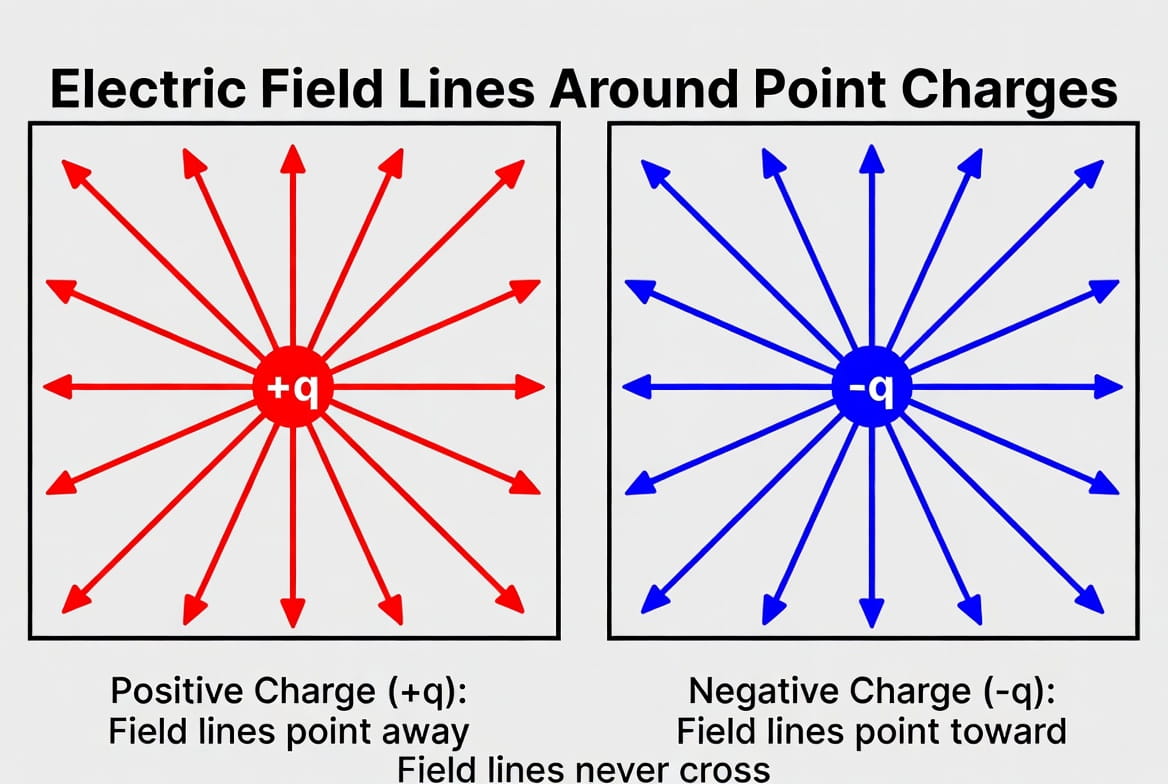
Field lines start on positive charges and end on negative charges. They never cross. Closer lines mean stronger field.
Properties of electric field lines:
- They point in the direction a positive test charge would move.
- Density of lines shows field strength (closer = stronger).
- They start on + charges and end on – charges.
- They are perpendicular to conductors in electrostatic equilibrium.
Real-Life Examples of Electric Fields
Lightning
Huge electric fields build up between clouds and ground until the air breaks down and a giant spark occurs.
Old CRT Televisions
Strong electric fields accelerated electrons to create the picture on the screen.
Capacitors in Electronics
Uniform electric fields store energy in phones, cameras, and power supplies.
Photocopiers & Laser Printers
Electric fields attract toner particles to paper in precise patterns.
Step-by-Step Solved Problems
Problem 1: A test charge of +2 μC experiences a force of 0.004 N to the right in an electric field. What is the electric field strength and direction?
Solution: E = F / q = 0.004 / (2×10⁻⁶) = 2000 N/C to the right.
Problem 2: Calculate the electric field 0.3 m away from a +5 μC point charge.
Solution: E = (9×10⁹ × 5×10⁻⁶) / (0.3)² = 500,000 N/C (away from the charge).
Problem 3: Two parallel plates are separated by 0.02 m with a 120 V potential difference. Find the uniform electric field between them.
Solution: E = V / d = 120 / 0.02 = 6000 V/m (or N/C).
Common Mistakes Students Make
- ❌ Thinking electric field is the same as electric force (E is force per unit charge)
- ❌ Forgetting that electric field is a vector (direction matters)
- ❌ Confusing N/C and V/m — they are actually the same
- ❌ Drawing field lines that cross or start/end in empty space
Continue Mastering Physics Fundamentals: