Kinematic Equations in Physics: The Complete Guide to Formulas, Derivations, Examples & Applications
Master the 4 kinematic equations (the BIG 4) with clear explanations, step-by-step derivations, solved problems, and real-world applications. Perfect for students learning 1D and 2D kinematics, constant acceleration motion, and the fundamentals of physics.
Jump to a Section:
What Is Kinematics?
Kinematics is the branch of physics that studies the motion of objects without considering the forces that cause the motion. It focuses purely on position, velocity, acceleration, and time — the “geometry of motion.”
The word comes from the Greek kinesis (motion). Unlike dynamics (which includes forces and Newton’s laws), kinematics answers questions like: “How far does the car travel?” or “How long until it stops?”
Kinematics applies to constant-velocity motion and constant-acceleration motion (the most common cases in introductory physics). For everything else, we use more advanced methods.
→ Learn the full definition and history in our dedicated guide: What Is Kinematics? Definition and Examples
Key Variables in Kinematics
All kinematic equations use five core variables:
| Variable | Symbol | Meaning | SI Unit | Direction Matters? |
|---|---|---|---|---|
| Displacement | Δx or s | Change in position | meters (m) | Yes (vector) |
| Initial velocity | v₀ or u | Velocity at start | m/s | Yes |
| Final velocity | v | Velocity at end | m/s | Yes |
| Acceleration | a | Rate of change of velocity | m/s² | Yes |
| Time | t | Duration | seconds (s) | No |
Pro tip: Always choose a positive direction (e.g., right or up) and stick to it. Negative values indicate opposite direction.
The Four Kinematic Equations (The BIG 4)
These equations only work when acceleration is constant. Here they are in standard form (using Δx for displacement):
1. v = v₀ + a t
(final velocity = initial velocity + acceleration × time)
2. Δx = [(v + v₀)/2] × t
(displacement = average velocity × time)
3. Δx = v₀ t + ½ a t²
(displacement = initial velocity × time + ½ acceleration × time²)
4. v² = v₀² + 2 a Δx
(final velocity squared = initial velocity squared + 2 × acceleration × displacement)
Mnemonic: Many students remember them as the “BIG 4.” Each equation is missing one variable, so you can always solve for the unknown if you know the other three.
Derivations of the Kinematic Equations
Understanding why the equations work builds intuition.
- Equation 1 comes directly from the definition of acceleration: a = (v – v₀)/t → rearrange → v = v₀ + a t
- Equation 2 uses average velocity: For constant acceleration, v_avg = (v + v₀)/2. Displacement = v_avg × t
- Equation 3 substitutes Equation 1 into the average-velocity form and simplifies algebraically.
- Equation 4 eliminates time by solving Equation 1 for t and substituting into Equation 3.
Full step-by-step derivations with algebra are in our dedicated page: Derivation of Kinematic Equations
Visualizing Kinematic Motion – Velocity-Time Graph
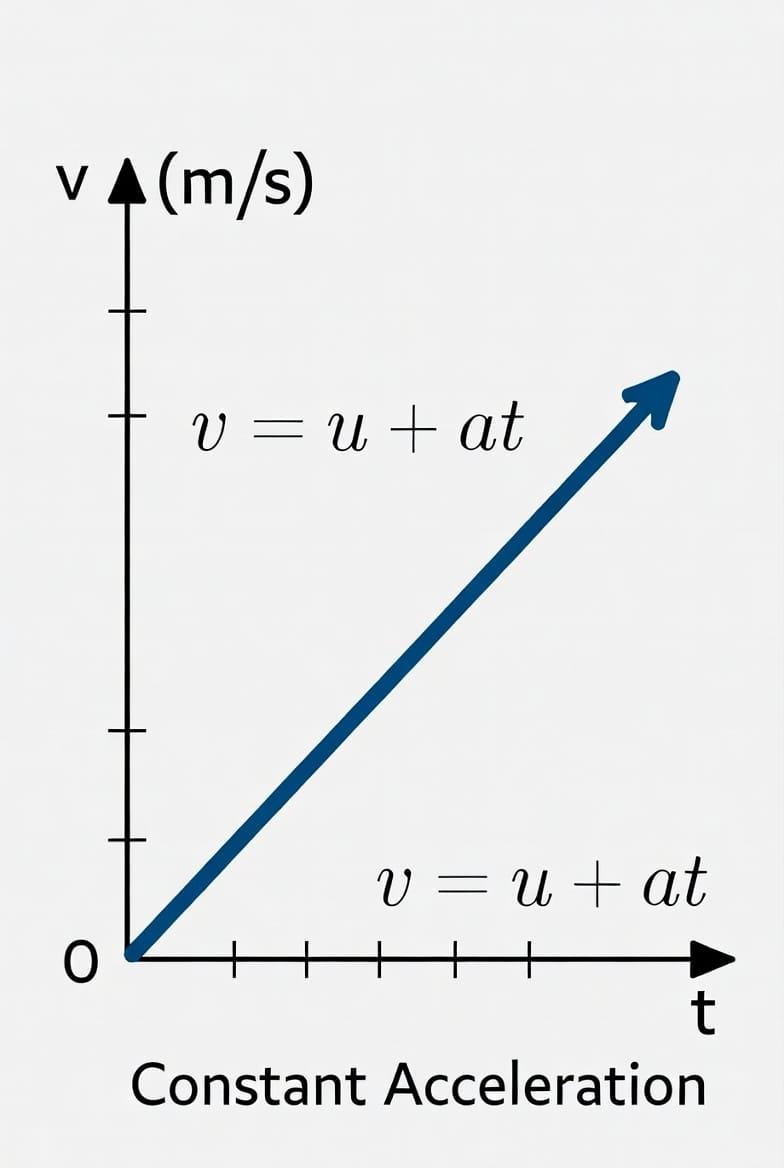
Velocity-time graph for an object with constant positive acceleration. The slope equals acceleration, and the area under the curve equals displacement.
When and How to Choose the Right Equation
Use kinematic equations only when acceleration is constant. Common scenarios: free fall, cars accelerating uniformly, projectiles (separate x and y).
| Unknown Variable | Known Variables | Best Equation |
|---|---|---|
| v | v₀, a, t | 1 |
| Δx | v, v₀, t | 2 |
| Δx | v₀, a, t | 3 |
| v | v₀, a, Δx | 4 |
Tip: List what you know and what you need. Pick the equation that contains the unknown but omits only one known value.
Step-by-Step Problem-Solving Strategy
- Read the problem twice.
- List knowns and unknown (include signs and units).
- Choose the equation.
- Substitute and solve.
- Check units and reasonableness.
Solved Examples
Example 1 (Equation 1)
A car starts from rest (v₀ = 0) and accelerates at 4 m/s² for 7 s. What is its final velocity?
Solution: v = 0 + (4)(7) = 28 m/s
Example 2 (Equation 3/4)
A ball is thrown upward at 20 m/s. How high does it go before stopping (a = –9.8 m/s²)?
Solution: At the top v = 0. Using v² = v₀² + 2aΔx → height = 20.4 m
Full step-by-step solutions for 8+ more examples (including free-fall and 2D motion) are available here: Kinematic Equations Solved Problems →
1D vs 2D Kinematics
In 1D, motion is along a straight line (use the equations directly).
In 2D (e.g., projectiles), treat x and y separately with a_x = 0 and a_y = –g.
→ Master both in our dedicated pages: 1D Kinematics Equations and 2D Kinematics & Projectile Motion
Real-World Applications
Automotive Safety
Calculating braking distance using kinematic equations.
Sports Physics
Basketball free throws and baseball trajectories.
Engineering
Roller-coaster design and robot arm motion.
Astronomy
Satellite orbits approximated with segments of constant acceleration.
Kinematics vs Dynamics
Kinematics = “how” (motion description).
Dynamics = “why” (forces cause the motion).
They work together: kinematics gives the numbers; dynamics explains them via F = ma.
Full comparison: Kinematics vs Dynamics →
Frequently Asked Questions
What are the 4 kinematic equations?
See the BIG 4 list above. They relate displacement, initial/final velocity, acceleration, and time under constant acceleration.
Do kinematic equations work for non-constant acceleration?
No — only constant acceleration.
What if time is unknown?
Use Equation 4 (v² = v₀² + 2 a Δx).
Are there only 3 kinematic equations?
Some textbooks list 3; most use 4. All are equivalent.
Continue Mastering Physics Fundamentals on physicalfundamentals.info:
Mastering kinematic equations opens the door to all of mechanics. Practice with the examples, use the linked sub-pages, and you’ll solve any constant-acceleration problem with confidence.
Last updated: April 2026 | Written for students by physics educators at physicalfundamentals.info