Rotational Equilibrium: Conditions, Torque & Real-Life Examples
Learn why a seesaw balances, how ladders stay upright, and the powerful condition Στ = 0. Master torque calculations with diagrams and solved problems.
What is Rotational Equilibrium?
Rotational equilibrium occurs when an object is not rotating or is rotating at a constant angular velocity. This means the net torque acting on the object is zero.
For complete static equilibrium, two conditions must be satisfied:
- Net force = 0 (translational equilibrium – from Newton’s First Law)
- Net torque = 0 (rotational equilibrium)
This concept builds directly on Newton’s laws and is essential in classical mechanics.
The Key Condition
Sum of all torques = 0
τ = r × F × sinθ
(r = distance from pivot, θ = angle between force and lever arm)
Newton-meters (N·m)
Understanding Rotational Equilibrium Step by Step
Torque measures how effectively a force causes rotation. Even a small force applied far from the pivot can produce large torque.
The sign convention is important: clockwise torques are usually negative, counterclockwise positive (or vice versa — choose one consistently).
- Longer lever arm → greater torque
- Force perpendicular to lever arm (θ = 90°) → maximum torque
- Net torque = 0 means the object will not start rotating or change its rotation speed
How to Solve Rotational Equilibrium Problems
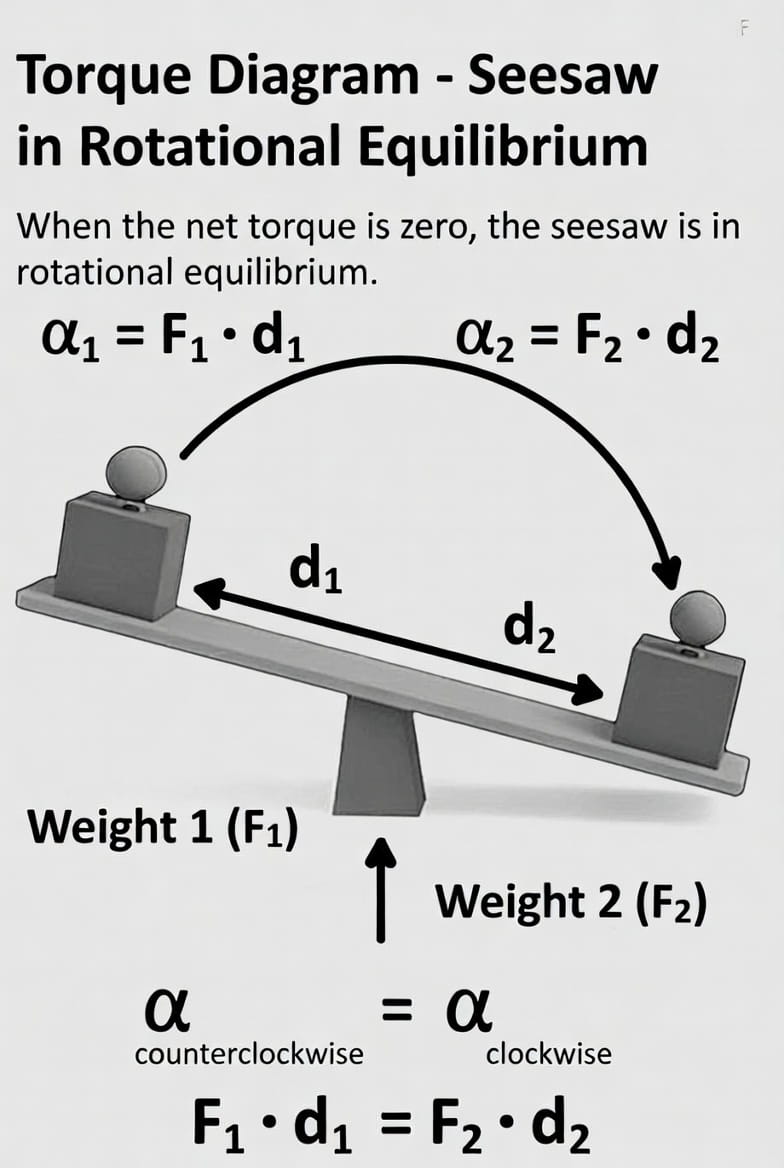
Choose a pivot point, calculate clockwise and counterclockwise torques, and set Στ = 0
Real-Life Examples of Rotational Equilibrium
Balanced Seesaw
Heavier child sits closer to the pivot so that clockwise and counterclockwise torques cancel.
Ladder Against Wall
Friction at the base and normal force at the wall produce torques that keep the ladder from rotating.
Opening a Door
Pushing near the hinges requires much more force than pushing at the handle (longer lever arm).
Construction Crane
Counterweights balance the load so the net torque about the pivot is zero.
Step-by-Step Solved Problems
Problem 1: A 60 kg child sits 2.0 m from the pivot on a seesaw. Where should a 40 kg child sit to balance it?
Solution: Clockwise torque = counterclockwise torque → 60 × 9.8 × 2.0 = 40 × 9.8 × d → d = 3.0 m
Problem 2: A uniform 10 kg beam of length 4 m is supported at one end. A 30 kg mass is placed 3 m from the support. What upward force is needed at the other end to keep it horizontal?
Solution: Choose pivot at support → Στ = 0 → (30×9.8×3) + (10×9.8×2) = F × 4 → F = 245 N
Problem 3: Why is it easier to open a door by pushing at the handle instead of near the hinges?
Answer: Larger lever arm (r) produces greater torque for the same force (τ = rF sinθ).
Common Mistakes Students Make
- ❌ Forgetting that you must choose the same pivot point for all torques
- ❌ Using force instead of the perpendicular component (forgetting sinθ)
- ❌ Ignoring the weight of the beam itself when it is uniform
- ❌ Confusing rotational equilibrium with translational equilibrium
Continue Mastering Physics Fundamentals: