Transverse Waves Explained: Definition, Diagram & Real-Life Examples
Master one of the most important concepts in physics fundamentals. Learn what transverse waves are, their key parts, properties, and how they appear everywhere — from light to music.
Table of Contents
What Is a Transverse Wave?
A transverse wave is a wave in which the particles of the medium oscillate perpendicular (at right angles) to the direction in which the wave travels.
In simple terms: The wave moves forward, but the material (or field) moves up-and-down or side-to-side — not forward and backward.
This is one of the two main types of mechanical waves (the other being longitudinal waves). Electromagnetic waves like light are also transverse.
Labeled Diagram of a Transverse Wave
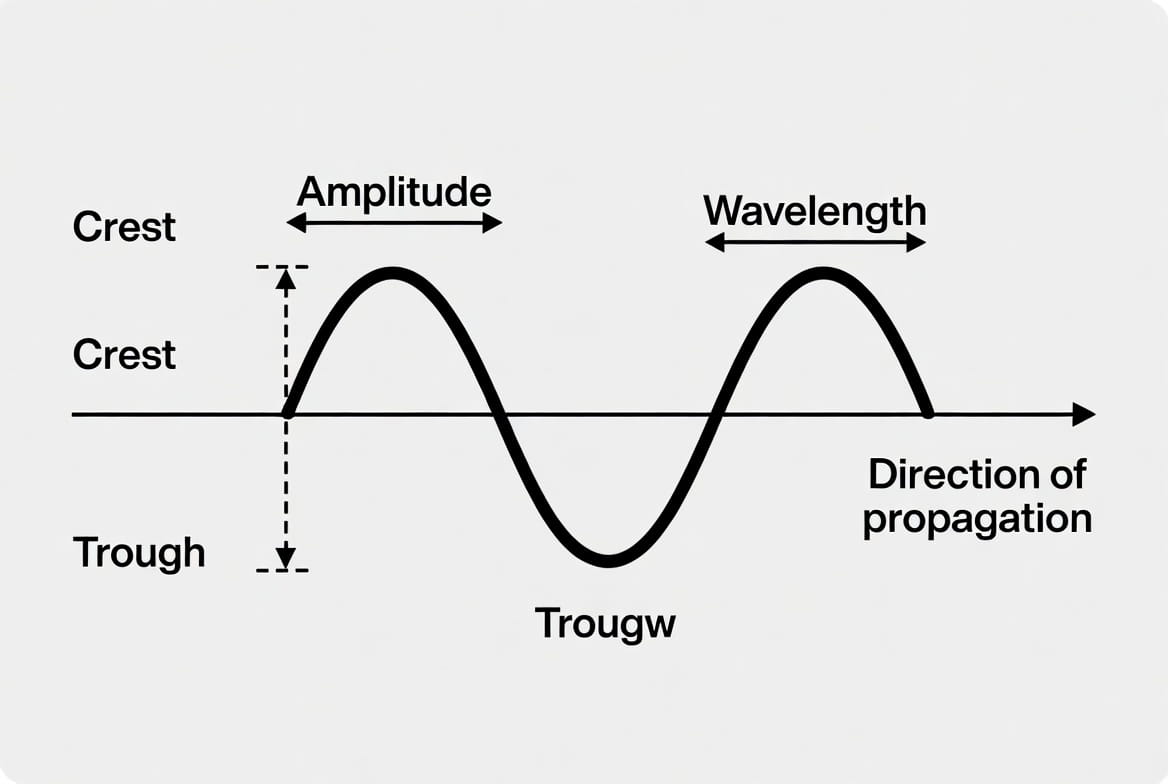
Crest (highest point) • Trough (lowest point) • Amplitude • Wavelength • Direction of wave travel
Main Parts
- Crest — The highest point of the wave
- Trough — The lowest point of the wave
- Amplitude — Maximum displacement from rest position (height of crest or depth of trough)
- Wavelength (λ) — Distance between two consecutive crests or troughs
Important Terms
- Frequency (f) — Number of waves passing a point per second (unit: Hertz)
- Period (T) — Time for one complete wave (T = 1/f)
- Wave Speed (v) — How fast the wave travels (v = f × λ)
Key Properties of Transverse Waves
Real-World Examples of Transverse Waves
Guitar / Violin Strings
When you pluck a string, it vibrates up and down while the wave travels along the string.
Ripples on Water Surface
Water particles move up and down; the wave spreads outward.
Light and Electromagnetic Waves
All visible light, radio waves, and X-rays are transverse.
Stadium Wave (“Mexican Wave”)
People stand and sit perpendicular to the direction the wave travels around the stadium.
Transverse vs Longitudinal Waves
| Feature | Transverse Wave | Longitudinal Wave |
|---|---|---|
| Particle Motion | Perpendicular to wave direction | Parallel to wave direction |
| Examples | Light, string waves, water ripples | Sound waves, spring compressions |
| Can be Polarized? | Yes | No |
Wave Speed, Frequency & Wavelength
The fundamental relationship:
Where v = wave speed, f = frequency, λ = wavelength.
Quick Practice Problems
Try these (answers at the bottom):
- A transverse wave has frequency 5 Hz and wavelength 2 m. What is its speed?
- Name two real-life examples of transverse waves you see every day.
Continue your Physics Fundamentals journey: